Thais Glenn Coaching
Blog & Podcast

One evening on the couch is a behavior, not an identity. A simple three-step practice to stop solving the wrong problem.
You were exhausted. You took care of the kids, your work, the house. Everything is done. The kitchen is clean, because a girl has to have the kitchen clean before she can rest, right?
Finally, some time for yourself.
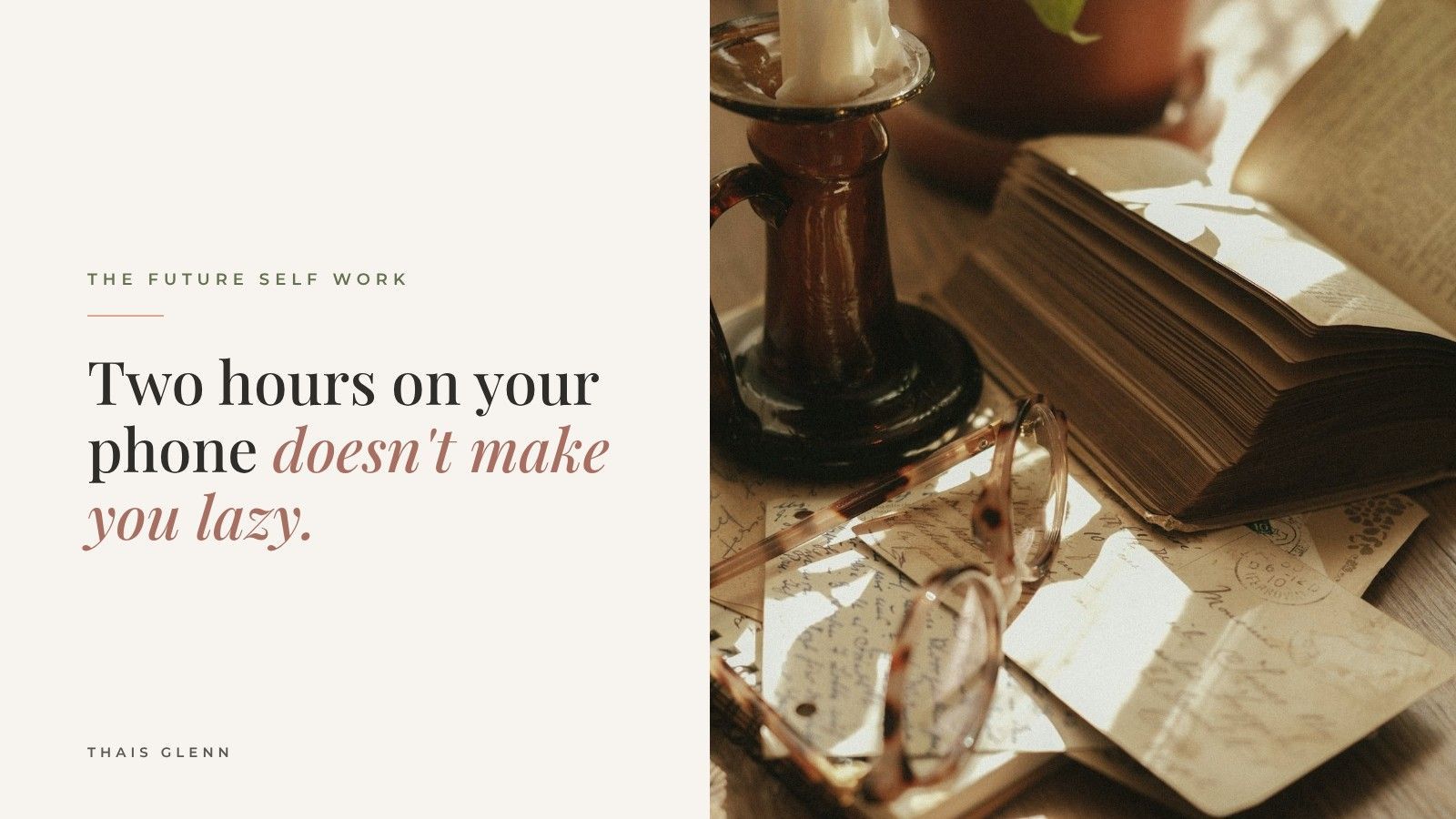
So what do you do? You lie on the couch, put on a show you have already seen many times, pick up your phone, and scroll. And scroll. For hours.
And then the thought comes: "I did it again. The only time I had for myself, I wasted."
The empty promises
What usually comes next are promises.
I need a better routine. I need better time management. On Monday things will be different. Maybe I should buy another course.
Here is what happened. You concluded that the problem was your discipline, your habits, your routine. And then you went looking for something to fix that problem.
That, my friend, is how you start solving the wrong problem.
Behavior or identity?
Let's look at it again.
What happened: I sat on the couch and scrolled for two hours.
What I made it mean: I have no discipline. I'm lazy.
The first one is behavior. The second one is identity.
This is what I call an identity conclusion. We take one behavior, or one feeling, and use it as evidence of who we are. And it's not fair, because it's not true. Nothing about that evening proves you are lazy. The only thing we can prove is that you lay down on the couch.
Notice. Understand. Practice.
If you want to stop solving the wrong problem, take a step back before deciding what has to change. Grab a piece of paper and write three words.
1. Notice. What actually happened? Just the facts. Then ask: what did I make it mean about me?
2. Understand. What am I actually frustrated about? Sitting on the couch with your phone is not the problem. Some days you might even feel grateful for that time. In my example, the frustration was something else: I poured myself into everybody the whole day, and when I finally had time for me, it was just the scraps. I still didn't feel rested.
So the frustration is not the problem. It is data. It shows you what is missing, maybe real rest, maybe presence, maybe the feeling of having a choice.
3. Practice. Awareness alone stays in your head, and mindset can only take you so far. If nothing changes, nothing changes. So ask: who do I want to practice being in the way I respond to what matters to me?
From conclusion to direction
This is where your future self becomes useful. Not as someone new or someone different, but as a point of reference.
If what matters is real rest, the old conclusion "I'm lazy" can become a new sentence:
I am becoming a woman who makes room for real rest in her life.
Then give that sentence one small behavior. For example: before I open social media at night, I will ask myself what would actually feel restorative right now.
This is not about morality. Scrolling is not bad and reading is not better. It's about interrupting an automatic pattern so you can make a more deliberate choice. Maybe you read a book. Maybe you watch the show you actually wanted to see, instead of background noise.
Every behavior creates evidence of who you are. The question is which identity that evidence is building.
You don't become your future self after everything in your life has changed. You become her through the way you practice living your life right now.
Want to go deeper with me? Get my free audios here.